How they work, which squeeze suits your camera and what to check before the shoot. With the manufacturers' data.
Photo: Anthony Sebbo / Unsplash
In 30 seconds
An anamorphic lens squeezes the image horizontally. In post it is stretched back out and the frame becomes wide, with oval bokeh and horizontal flares.
Choose the squeeze to suit the sensor: 1.33x for 16:9 cameras, 1.5x for full frame, 2x for near-square areas such as the ALEXA 35's 6:5.
Check coverage before you book: the image circle must hold at least the 2.39 frame you will use.
Inside an anamorphic lens there is a group of cylindrical elements that works on one axis only: it squeezes the image horizontally and leaves the vertical as it is. The compression factor is called the squeeze. In the edit, or already on the monitor on set, the image is stretched back out by the same factor: this is the de-squeeze.
[[g:desqueeze]]
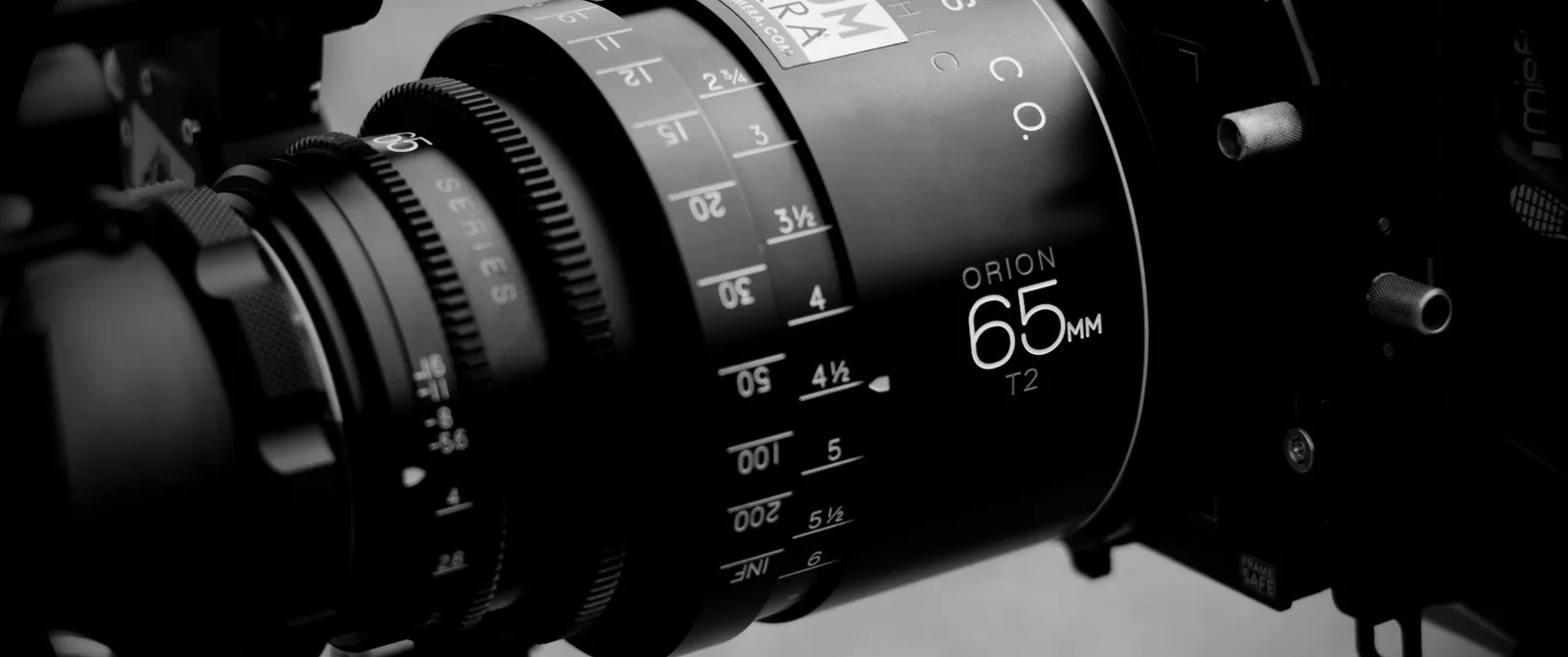
There is also a less obvious effect, which the ASC explains well in its “Practical Optics” series. With a 2x lens the horizontal field of view is about twice that of a spherical lens of the same focal length, but the depth of field stays that of the focal length. A 2x 50 mm frames as wide as a 25 mm and throws the background out of focus like a 50. That is why the background separates even without opening the iris all the way.
Photo: Sasun Bughdaryan / Unsplash
The look
An anamorphic lens shows its character above all in the highlights. In the frame below you can move the light source and change lens.
[[g:flare]]
Bokeh turns oval
When the cylindrical group sits at the front, in so-called front anamorphics, out-of-focus points of light stretch vertically. Cooke points out that designs with the cylinder at the rear behave almost like spherical lenses: the bokeh stays rounder.
Flares stretch horizontally
Reflections inside the lens are pulled out into a line. Their colour depends on the coatings and on the light that causes them: blue on the Atlas Orion, gold on the Mercury, neutral silver on the Blazar Cato.
The edges have character
A little barrel distortion, a slight vertical stretch wide open. Almost every series improves when stopped down by one or two stops: in the Newsshooter review the Blazar Cato 125 mm performs best at around T5.6.
A wide frame changes the composition: more room at the sides, horizontal lines in the foreground. Photo: Daniel von Appen / Unsplash
Squeeze and aspect ratio
The maths is simple: the aspect ratio of the sensor area you record, multiplied by the squeeze, gives the final ratio. From there you crop to the delivery format, almost always 2.39:1. The less you crop, the more resolution you keep.
16:9 with a 1.33x: 2.37:1, practically scope already.
16:9 with a 1.5x: 2.67:1, with a little cropped at the sides.
ALEXA Mini LF Open Gate with a 1.5x: 2.16:1, cropped top and bottom.
6:5 with a 2x: 2.4:1, which ARRI rounds to 2.39.
[[g:calc]]
In cinemas 2.39 is delivered inside a scope DCP container, 4096×1716 pixels in 4K or 2048×858 in 2K, with square pixels. So the de-squeeze has to be done before delivery, not after.
Camera and coverage
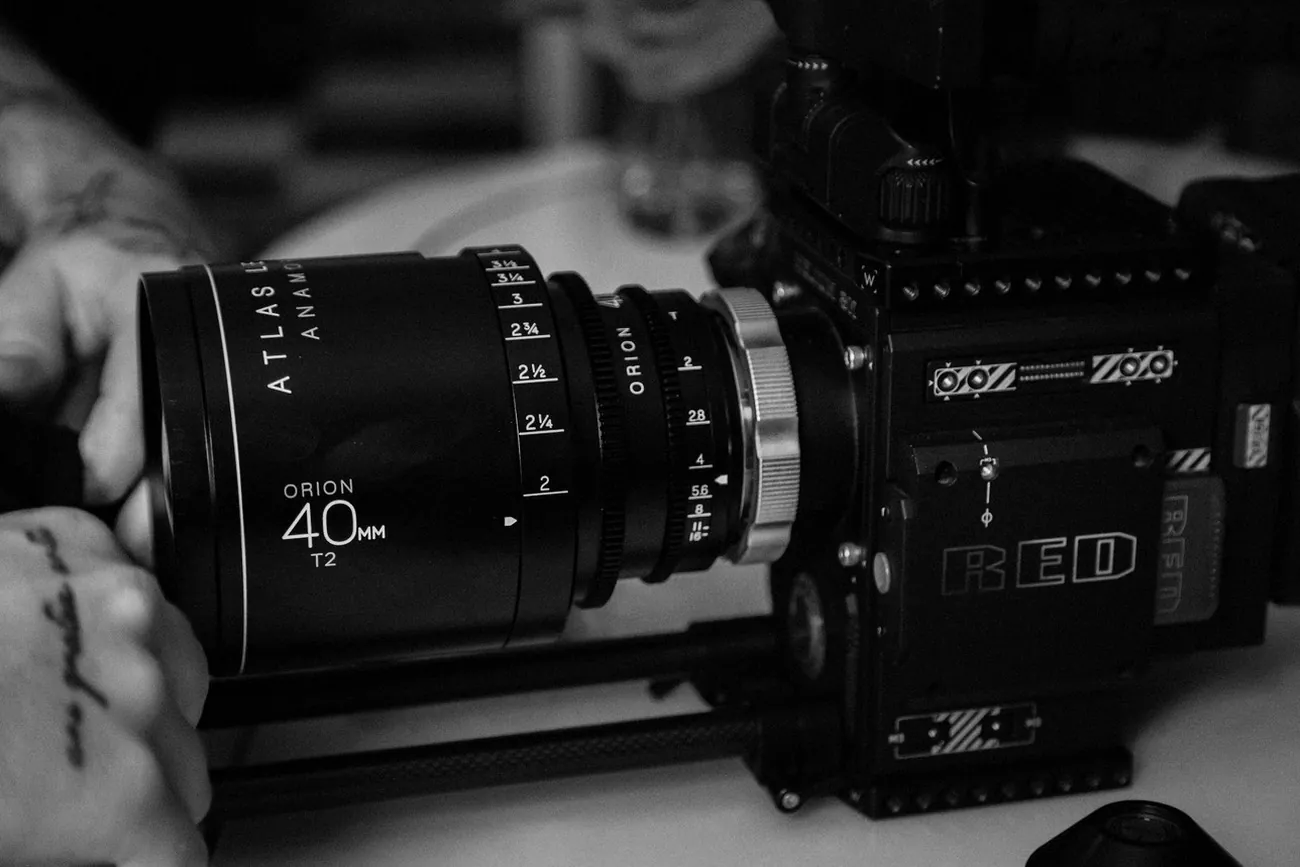
An Atlas 40 mm anamorphic on a RED camera. Photo: Jakob Owens / Unsplash
2x lenses want a near-square area, 1.33x lenses sit well on a 16:9 sensor, and 1.5x lenses are halfway between. Here is what the manufacturers say about the cameras most often rented for this kind of work.
ARRI ALEXA 35. For 2x lenses there is the 3.3K 6:5 mode, 20.22×16.95 mm, which gives 2.4:1 once de-squeezed. The ARRI Open Gate/Anamorphic licence must be active on the camera.
ARRI ALEXA Mini LF. Open Gate records 36.70×25.54 mm and is the mode ARRI recommends for full-frame anamorphics. The Atlas Mercury covers it fully; Super 35 2x lenses do not.
Sony FX6. Records 3840×2160 and 4096×2160. 1.3x and 2x de-squeeze arrived with firmware 4.0, 1.5x with 5.0. It applies to the viewfinder and the HDMI output, not to the RAW output.
Sony FX3. It has no open gate: with a 1.33x, 16:9 reaches 2.37:1 with almost no cropping. 1.3x and 2x de-squeeze have been there since firmware 3.00, 1.5x and 1.6x since 7.00. PL lenses need an adapter for the E-mount.
Then there is coverage. The lens's image circle must contain the recorded area, or at least the 2.39 frame you will use. Below, everything is to scale, with the manufacturers' measurements.
[[g:coverage]]
The rental kits
Six series, all with a PL mount: from the Viltrox 1.33x, designed for 16:9 cameras, to the Cooke 2x for Super 35. Choose your camera and the ones that suit it stay highlighted.
[[g:finder]]
[[g:lenses]]
Before the shoot
Photo: Jakob Owens / Unsplash
Mount. All the kits are PL. On bodies with an E, RF or L mount, add the adapter to the quote together with the lenses.
Weight and support. Arcana, Remus and Cato are under a kilo per lens. The Cookes weigh 3.2 to 5.2 kg: you need rods, a lens support and a suitable head.
Matte box. Front diameters range from 80 to 136 mm. Choose the matte box for the widest lens in the kit and use adapter rings for the others.
Minimum focus. From 0.44 m (Cooke 65 macro) to 1.2 m (Cooke 100). For tight details, plan for diopters.
Monitors. The same de-squeeze factor on the camera, the operator's monitor and the director's monitor.
Camera test. A point light source in frame for the flares, straight lines near the edges for distortion, the final frame lines drawn on the monitor.
Post. In DaVinci Resolve the de-squeeze is set in Clip Attributes, under Pixel Aspect Ratio.
Viewfinder and monitor must show the image already de-squeezed. Photo: Billy Freeman / Unsplash
A little history
Anamorphic is almost a hundred years old, and it began with an astronomer.
[[g:timeline]]
1926 Henri Chrétien patents the Hypergonar, an attachment that squeezes the image during shooting and stretches it back out in projection.
1927 Claude Autant-Lara is the first to use it, for “Construire un feu”.
1952 20th Century Fox buys the rights to the invention.
1953 On 16 September “The Robe” launches CinemaScope, at 2.55:1 with magnetic sound.
1957 With the optical soundtrack the format settles at around 2.35:1.
1958 Panavision's Auto Panatar eliminates the “mumps”, faces that widened at close focus.
1971 Scope moves to 2.39:1, which many still call 2.40.
2022 The Atlas Mercury brings native 1.5x to full frame.
2026 At NAB in April DZOFilm unveils the Arcana 1.5x, with an oval iris.